





Infertility Treatment Services

Infertility Treatment Approaches
The treatment process for infertility begins with a physical examination and diagnostic tests to identify factors that may affect the ability to conceive, as well as factors that could influence the woman’s health during pregnancy and the baby’s health in the womb.In general, infertility diagnosis and consultation involve the following steps:
Medical history taking
Blood testing
Ultrasound examination of the female reproductive organs
Semen analysis for the male partner
This method predicts the ovulation day to plan natural sexual intercourse during the woman’s fertile period. It is suitable for younger couples who can still conceive naturally.
Timed Intercourse in a Natural Cycle: A transvaginal ultrasound is used to monitor follicle growth during mid-cycle to predict the ovulation date. Sometimes, an ovulation trigger injection may be used to ensure timely ovulation and intercourse.
Timed Intercourse with Ovulation Stimulation Medication: Start taking ovulation induction medication on day 2–3 of the menstrual cycle (the first day of menstruation is counted as day 1). A transvaginal ultrasound is performed on day 12–13 to check follicle size. Once mature follicles are observed, an ovulation trigger injection is given, and the couple is advised on the optimal time for intercourse.
IUI is a form of assisted reproduction where sperm is washed and concentrated to select actively motile sperm, which is then injected directly into the woman’s uterus to achieve natural fertilization. This technique is considered a simple and natural fertility treatment and can be done either in a natural cycle or with ovulation induction medication.
IUI in a Natural Cycle:
Notify the clinic on the first day of menstruation (counted as day 1).
Perform a transvaginal ultrasound around day 12–13 to check follicle size.
Administer an ovulation trigger injection and schedule the insemination day.
IUI with Ovulation Stimulation Medication:
Notify the clinic on the first day of menstruation (day 1).
Begin ovulation stimulation medication on day 2–3.
Perform a transvaginal ultrasound around day 12–13 to monitor follicle size.
Administer the ovulation trigger and schedule the insemination procedure.
* The success rate of IUI is approximately 10–15% per cycle.

This method involves fertilization outside the body, commonly known as IVF (In Vitro Fertilization).
The process begins with ovarian stimulation to produce multiple mature eggs. Once the follicles reach the desired size, egg retrieval and sperm collection are performed. Fertilization is then achieved in the laboratory using IVF or ICSI techniques. The resulting embryos are cultured for 5–6 days until reaching the blastocyst stage (a mature stage ready for implantation). The embryos are then transferred to the uterus or frozen for later transfer in a subsequent cycle.
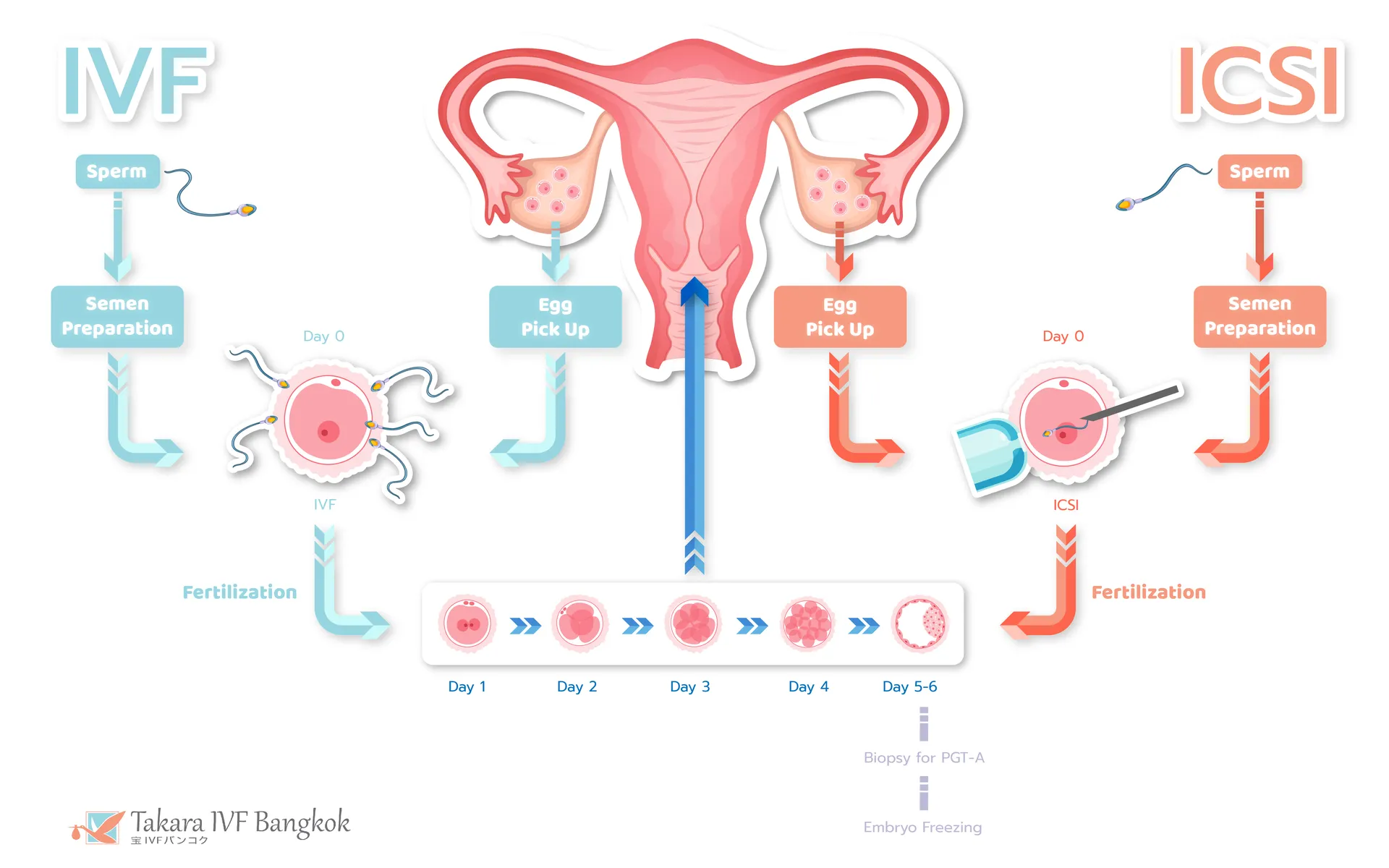
Difference Between IVF and ICSI
IVF: Washed sperm are placed around the eggs in a dish, allowing the strongest sperm to naturally penetrate the egg membrane for fertilization — mimicking natural conception.
ICSI (Intracytoplasmic Sperm Injection): A single healthy, motile sperm is injected directly into a mature egg under a microscope using specialized micromanipulation equipment. This method improves fertilization rates and reduces abnormal fertilization issues.
The success rate of IVF/ICSI is approximately 40–60%, depending on the couple’s overall health and reproductive condition.
IVF with Embryo Chromosome Screening
Embryo abnormalities can lead to implantation failure, incomplete implantation, or pregnancy with fetal chromosomal disorders—conditions commonly found in women aged 35 years or older.
Today, Preimplantation Genetic Testing for Aneuploidy (PGT-A) is used to screen embryos for chromosomal abnormalities and to select only normal embryos for transfer.
This technique increases pregnancy rates, reduces miscarriage risk, and lowers the chance of fetal abnormalities.

For men with severe sperm abnormalities, such as no sperm in ejaculate due to ejaculatory duct obstruction, congenital absence of the vas deferens, or previous vasectomy, or when all ejaculated sperm are non-viable,
sperm can be retrieved directly from the testicles through different techniques: PESA (Percutaneous Epididymal Sperm Aspiration): Using a fine needle to extract sperm from the epididymis. TESA (Testicular Sperm Aspiration): Used when obstruction cannot be clearly identified; sperm are aspirated directly from the testicular tissue. TESE (Testicular Sperm Extraction): A minor surgical procedure to remove small portions of testicular tissue for sperm retrieval.
Because the amount of sperm retrieved is usually very small, fertilization is typically achieved through ICSI. However, if the testes are unable to produce mature sperm, only immature sperm cells may be obtained, leading to lower treatment success rates.

Research has shown that frozen embryo transfer (FET) yields a higher success rate than fresh embryo transfer (performed in the same cycle as ovarian stimulation), since the body has time to reestablish hormonal balance after stimulation.
Steps for Frozen Embryo Transfer:
Begin endometrial preparation medication on day 2 of the menstrual cycle.
Perform transvaginal ultrasound to evaluate endometrial thickness and layering.
Start progesterone when the endometrium measures 7–8 mm or more and shows a triple-line pattern.
Schedule SEET / 2-Stage procedures and embryo transfer day. For SEET / 2-Stage techniques, SEET is performed 2–3 days after starting progesterone, and embryo transfer on day 5 after progesterone.
Techniques to Enhance Embryo Implantation:
